
Genealogy’s standard of proof assumes the records are there to be found. For some of our ancestors, they are not: the book burned, or rotted, or was never kept. This is the story of one of those ancestors — and of what we owe her.
For as long as I have researched my family — and it is thirty years now — Mary Quigley has been one of its oldest brick walls.
Mary died in Quebec City about 1860, still a young woman — though even that date is an inference, and I will come back to it. She was born in Ireland, and of her own beginnings almost nothing is known. No record names her parents. No record names her birthplace beyond Ireland. No record of her marriage to Samuel Jordan has ever been found, in Ireland or in Canada. In Canada she is Mary Quigley, and she is found in just two records — both of them her son William Robert’s: his baptism, and, years after she was gone, his marriage. Nobody ever changed her name, formally or otherwise. In Ireland, the family the DNA has now found for her is named Cogley. In Canada her name was simply written as it was heard — Quigley for Cogley, set down by the priests and ministers who wrote those records — and when William married, long after his mother was dead, it was written that way again. William was eight years old when she died; whether he ever knew her surname at all, I cannot say. What I can say is that the two names are one woman.
For most of those thirty years, all I had was the word Ireland. It was the DNA that gave the search a county: as my family’s matches gathered, they kept pointing to the same place — County Wexford, in the south-east — and so it was Wexford’s registers that I read, and read again.
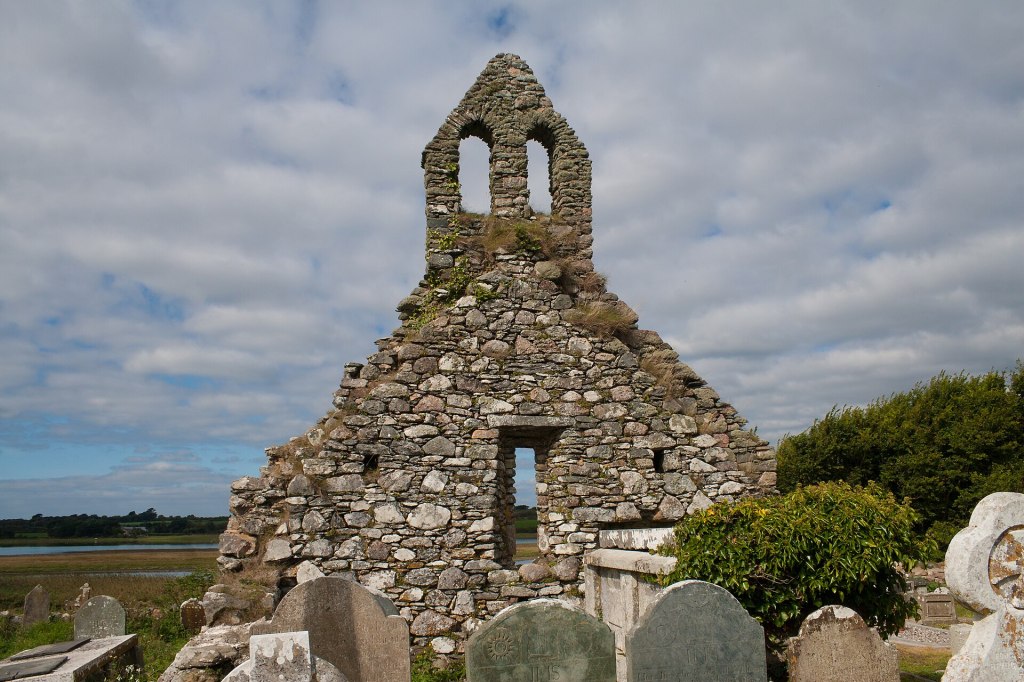
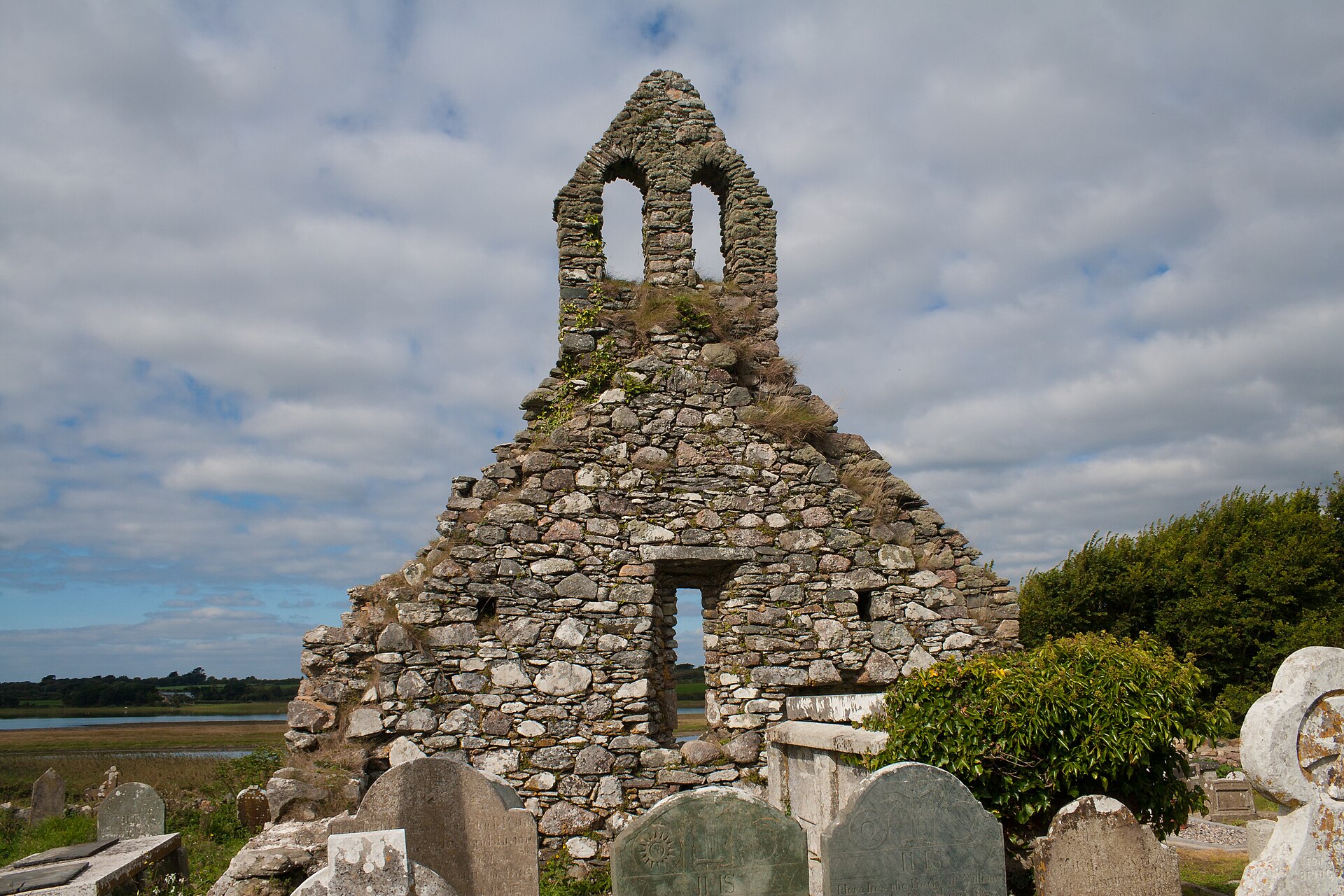
If Mary was a Catholic girl from County Wexford, as everything points to, her baptism would have been written in the register of the parish where she was born. For the Lady’s Island and Mayglass area of Wexford, the register book covering February 1818 to October 1827 is lost — and those are the very years her baptism would most likely have been written, if she was born in the mid-1820s, as the evidence suggests. The neighbouring register at Ballymore, the other book that might have held it, only begins in 1840. The years that do survive I have read page by page. The books are full of baptisms. Hers is not among them.
Canada kept as little of her as Ireland did. I have searched for her there the same way — census records, death records, burials. There is no death record for her, and no burial record. There is no birth or baptism record for her daughter Elizabeth Ann — born about 1860, about the time her mother died — though children of that time and place were baptised as a matter of course, and the absence is conspicuous. Her story is short, and it is closed: she died on 12 November 1877, aged seventeen, leaving no children — so there are no more records of her to find, and every descendant of Mary’s comes down through her brother William. The family does not appear in the 1851 Census of Canada at all. And she died about 1860, so the census of 1861 cannot help — she would not be in it in any case. Where was this family living, in those years, and why are they not where they should be? I still cannot answer that. In fact, the only reason her death is dated to about 1860 at all is that Samuel Jordan married again, at the tail end of 1860. Her death is inferred from her husband’s remarriage. Nothing more than that survives of the end of her life.
One more thing sits oddly with me, and I would rather say it than smooth it over. Mary was, to all intents and purposes, a Catholic girl — and Samuel Jordan was not a Catholic. I do not know how much it mattered at the time — to their families, or to their churches, or between the two of them. It may help explain some of the silence around this family in the records, and it may explain nothing at all. I leave it as a question, because that is what it is.
So here is the question I have had to sit with. What do we owe an ancestor when the proof we are trained to demand cannot exist?
Genealogy’s standard of proof assumes the records are there to be found — that if we are thorough enough, and honest enough, the paper will eventually speak. But some of our ancestors were written into books that burned, or rotted, or were simply never kept. If we hold those ancestors to the same standard, we are not being rigorous. We are sentencing them to be forgotten for the accident of which parish they were born in. Her lineage would stay off the tree forever — not because the evidence says it doesn’t belong, but because the one page that would prove it was lost two hundred years ago.
I don’t accept that. And in Mary’s case, I no longer have to, because the paper is not the only evidence there is.
But all was not lost. There was one more avenue left to try, and so I turned to the DNA — to the matches gathered over the years from my family’s testers, most of them small, most of them unexplained. When those matches’ trees are laid side by side, they do not scatter. Again and again they come back to County Wexford, and within Wexford to one small place on the south coast: Mayglass, in the parish of Lady’s Island. That is why the search went to Mayglass. It was not a guess at a map. It was where the matches were already pointing.
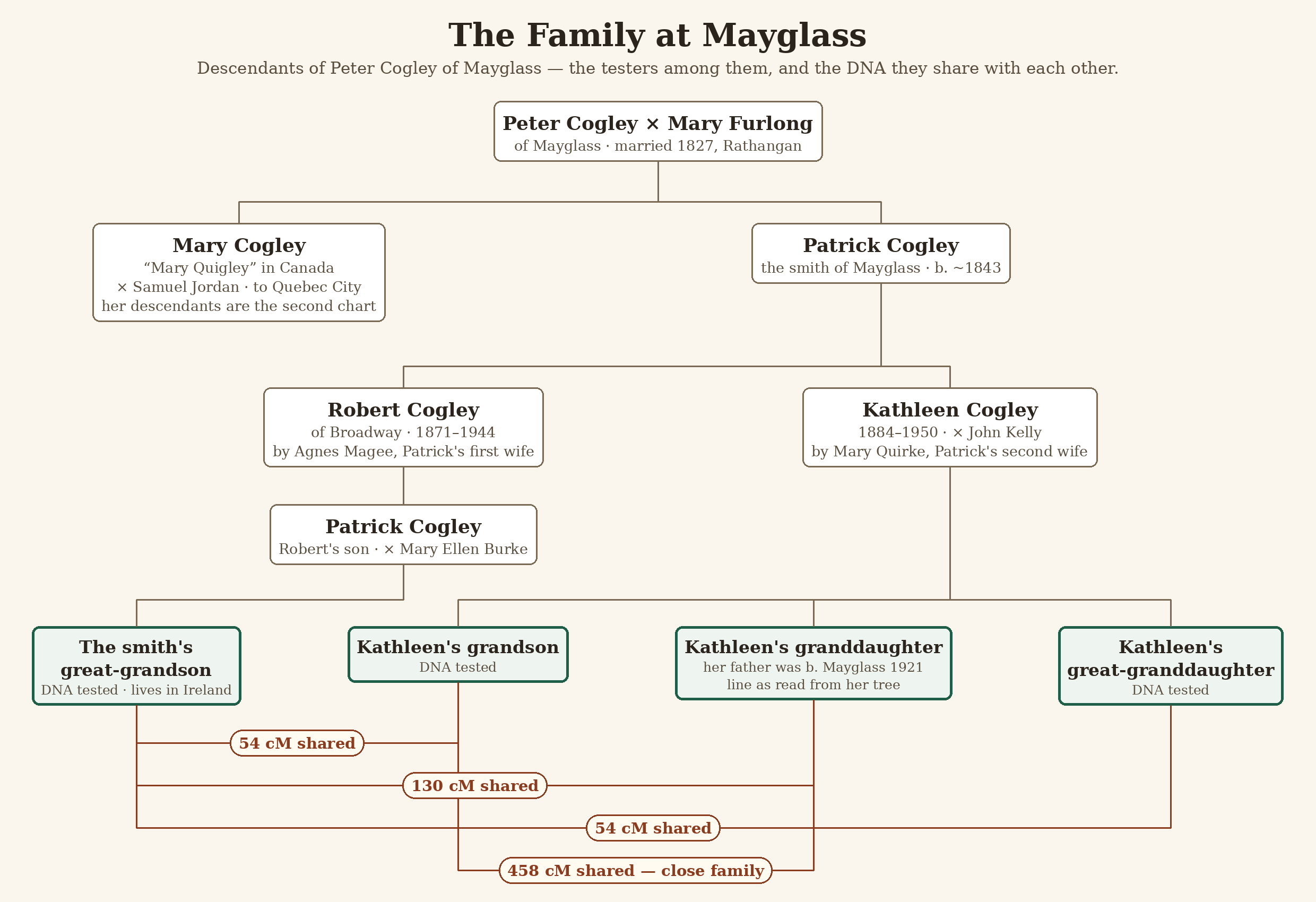
At the head of that family stands Peter Cogley, a labourer, who married Mary Furlong at Rathangan in November 1827 — one of the few paper records this family has. Peter’s son Patrick, born about 1843, was the blacksmith of Mayglass; his two marriage records name his father, and the second, in 1884, marks Peter dead. It is around Patrick and his children that the matches gather.
There are a great many matches in this story, and I am not going to walk through them all. Rather than bog anyone down in numbers and explanations, I will address only the key matches — the ones the proof actually rests on — and let two charts carry them. The first chart is the Mayglass family itself. Its testers — named here only by their relationship, as they are throughout — match each other, and match each other well. Kathleen Cogley’s grandson and her great-granddaughter each share 54 centimorgans with the blacksmith’s great-grandson, who still lives in Ireland. A woman whose father was born at Mayglass in 1921, and who is read as another of Kathleen’s granddaughters, shares 458 centimorgans with Kathleen’s grandson — close family — and 130 with the blacksmith’s great-grandson. Before our family enters the picture at all, the Irish family is one close-knit family, matching itself.
The same Patrick — the blacksmith’s great-grandson — stands at the foot of both charts. The second chart is our side: Mary’s descendants. Four of our family’s testers match him, and they do not stand in one generation. One is Mary’s great-granddaughter, in the closest generation of our family to have tested. The other three are a step further down — her great-great-grandchildren: two brothers of one branch, and a cousin of another. It is that spread, across two generations and three branches of William Robert’s family, that gives the numbers their weight. This is not one person’s stray match. It is the same man appearing, at the right distance, in branch after branch.
Fifteen descendants of Mary and Samuel Jordan have taken DNA tests. The matches highlighted here are the strongest among them — the ones found at Ancestry, where the Wexford family has tested.
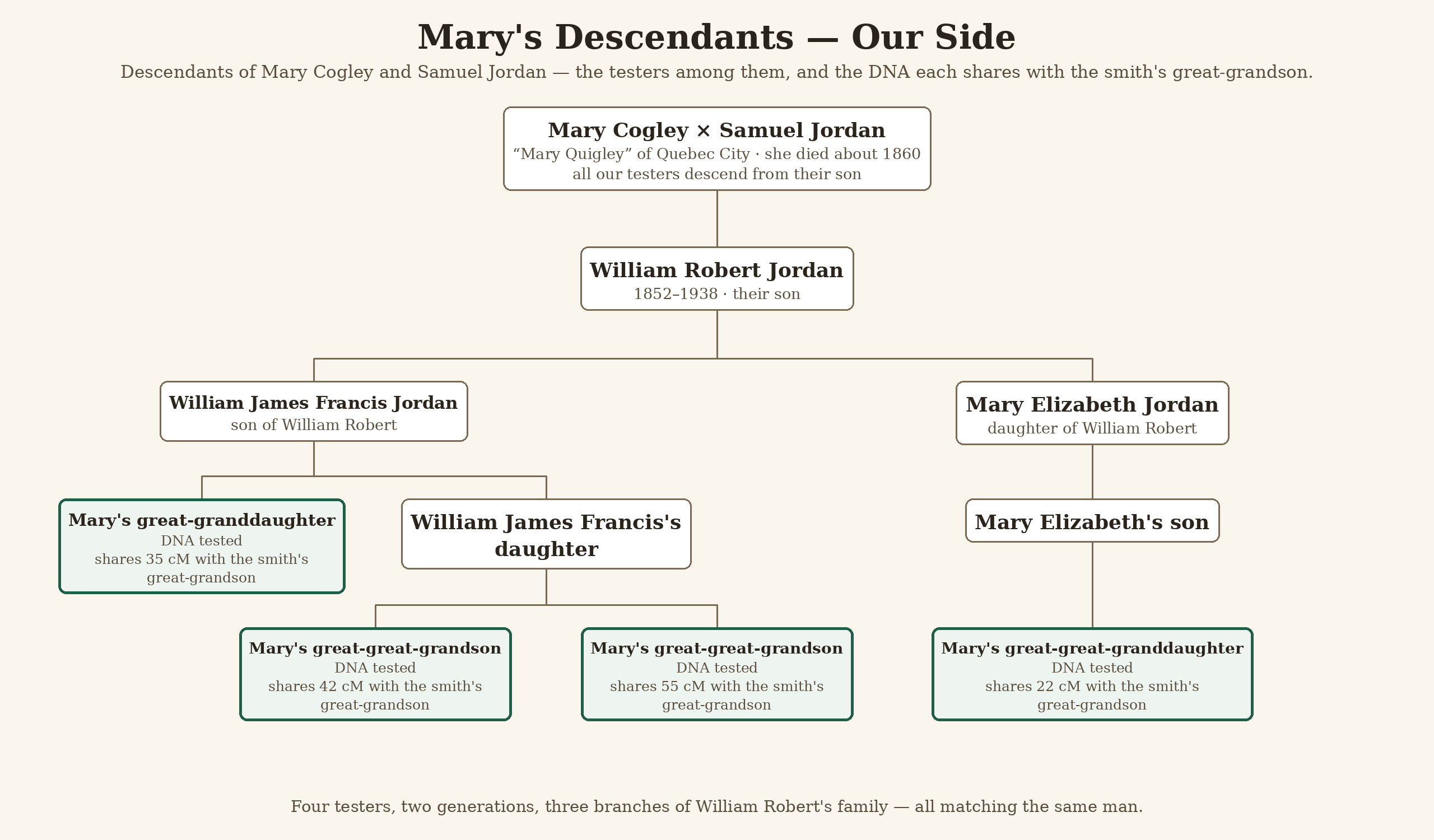
And there is only one seat in that family where Mary fits. If she was Peter Cogley’s daughter — an older sister of Patrick the blacksmith — then the amounts on the second chart fall exactly where they should, generation by generation. Push Mary a generation further back, or a generation further out, and every one of those figures comes out too large or too small. The DNA does not merely point at the Cogleys of Mayglass. It points at one place in the family, and it is hers.
I want to be plain about what this is and what it is not. What the DNA shows is that this is Mary’s family. It is the key — there is just no other way to explain this. The records will never lay it out. We have to use the DNA, and it is actually excellent proof.
Mary has always been in my tree. What I have done this week is claim her lineage: Mary Quigley Cogley, daughter of Peter Cogley of Mayglass — claimed on the DNA. But consider what it gives back. For thirty years, all I have ever been able to say about Mary was “Ireland.” Ireland — a whole country, and nothing more. Now I can tell my family that we have a place for her: Mayglass, in County Wexford — a parish on the south coast, with a father who was a labourer and a brother who was the blacksmith. She is there now, with her father, her brother, and the family the DNA gave back to her. On her page I left a single sentence, and I find I don’t need more than the one:
Mary is placed as the daughter of Peter Cogley of Mayglass on DNA evidence — no paper record ties her to Peter, because the register that would hold her baptism does not survive.
That statement says it all. She was always somebody’s daughter. Now we know whose.


Leave a Reply